
I'm Lovin it.
A defense of burgers, and an exercise in overthinking.

Disclaimer: Happy slightly-after-4/20! This post is part 1 in a 2-part series on “Burger-isms”. This is quite lighthearted, and a less edited prelude to the main release of this week on Sunday (which will be both more personal and relevant). Read to the end or else this won’t make much sense!
I have a deep, storied history with burgers.
Burgers have, inarguably, been my favourite meal ever since I first encountered them in an Indian McDonalds at the ripe age of 2. It’s my first memory; my mother walking around with me as I celebrated my second birthday with Ronald McDonald and Co.
Love at first sight, in more ways than one.
As I grew up, gaining independence (and weight), burgers became a refuge from the woes of life. Instead of badminton, I’d exercise my patience standing in line at the McDonalds, feigning a belly ache. Instead of tutoring, I’d study the menu of Burger King. Burgers became so vital to my identity that the Instagram handle I chose starts with a reference to the king of burgers (@bigmac).
Unhealthy, in more ways than one.
Of course, as my love for burgers came in conflict with my hormonal desire to look good, their presence in my life declined. Even still, I often find myself craving them deep in the night, both hungry and h___ (an inspiration for this post).
Motive.
Obsession leads the mind to strange places. To the uneducated, burgers are a mere genre of food. An aesthetic of Americana perversely associated to obesity, glut, and the American dream.
I don’t disagree, but my love, and consequential defense, for burgers is far too complex to capture in a mere sentence.
To me, burgers are a lesson in the power of simplicity. Perhaps I say this as a subconscious vindication of my writing, but burgers signify concepts more abstract than their initial appeal might suggest.
We’ve all been taught not to judge a book by its cover, so as you read the following defense, I ask that you extend the same courtesy to the misunderstood burger; don’t judge a burger by its buns, if you will.
Integrity.
As architecture evolved from the mud huts of Constantinople to the skyscrapers of New York, so did the construction of food. Adapting to the needs of the consumer, food’s passage of evolution tells a tale in itself.
Take modern sandwiches as an example.
Sure, people wrapped food all the time. The labour and travel of conquest demanded portable meals since the dawn of civilization. Jewish sages wrapped lamb in matzah, and Dutch grandmas came up with funny names for open-faced sandwiches (Belegde Broodjes).
But it was the demands of the Aristocrats of 17th century Europe, namely to play cards and indulge in salted beef simultaneously, that necessitated the production of a food that was protective, convenient, and (ideally) contained salted beef. With the ingenuity of a few creatives, these demands were met, yielding one of the most significant modern inventions as a consequence.
What are burgers but the next step in the same staircase of history?
The blueprint of a basic cheeseburger seems simple. Some combination of patties, cheeses, vegetables, and sauces, book-ended by two buns. Yet its simplicity understates the intent behind each component, making the end product far more than the sum of its parts.
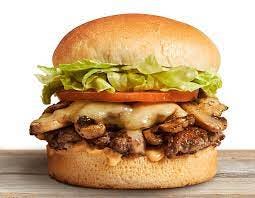
First, the patty. Indulgent, savory and crispy on the outside, moist and melt-in-your-mouth soft on the inside, with an irresistible umami quality that is perfectly balanced through the dealer’s choice of seasonings, the meticulous construction of a patty is vital in perfecting the ultimate burger. A mouthwatering vessel of textural variety and satisfying flavor, the patty provides a hearty and appetizing foundation that serves as the focal point of the burger experience.
Next, the cheese. The creamy, decadent cheese envelops the patty in a layer of melty goodness. Optional, sure, but in my eyes irreplaceable.
Third, the condiments. Sauces are the backbone of a good burger, often defining the identity of a burger. From Chick-Fil-A’s Chick-Fil-A sauce to the Big Mac’s Big Mac sauce (the lack of naming creativity is compensated for in flavour), some of the goliaths of the burger world are nothing without their sauces.
Then comes everything else. I generalise here because the optionality of a burger is the subsequent topic, but the everything else in question includes the tomatoes, lettuce, condiments, and anything else you like on your burger. Each is an accompaniment to the last. pickles provide an acidic burst of flavour that cuts through the richness of the meat. The lettuce adds a satisfying crunch, and the tomato a slight sweetness that refreshes the palate.
Each step in a burger’s assembly is guided by a delicate understanding of flavour, texture, and the interaction of ingredients. From the order they’re assembled in (e.g. the lettuce between the sauce and bun to prevent moisture seepage), to the amount offered (e.g. the iconic “3-pickle” method), the creators of the modern burger were no more precise and purposeful than the likes of Da Vinci and Picasso.
More than that, the burger provides a remarkable showing of structural integrity that strikes a balance between quantity and utility. Seldom does a dish provide such a rounded meal while also being functional.
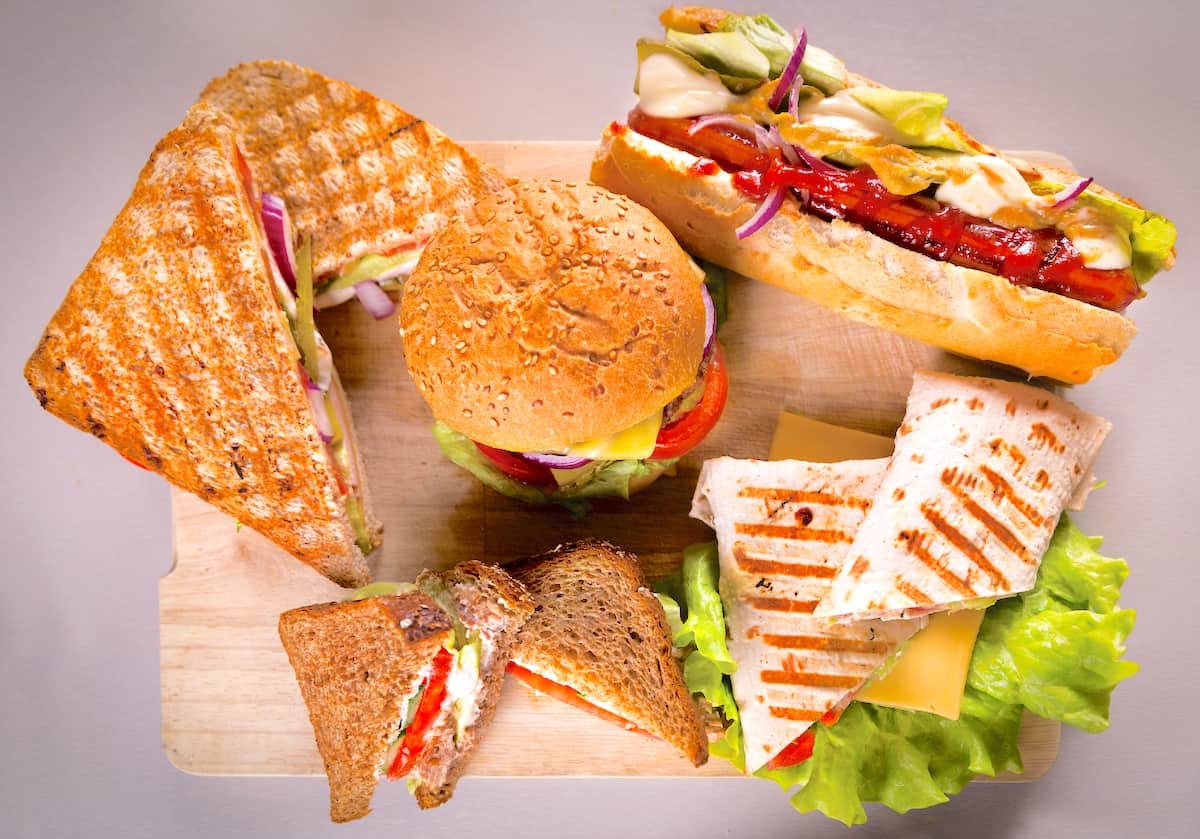
Sure, there’s the sandwich, but the round form of a burger avoids the all the structural problems of a sandwich while maintaining all its benefits.
An equidistant distribution of ingredients on a radial surface mean you don’t have to awkwardly bite through edge pieces.
The lack of a distinct border decreases waste in the form of off-cuts, or sitting through the dry texture of the outside of a loaf.
You can cut a burger in an infinite number of ways, while a sandwich restricts you to a nigh-impossible choice between the straight and the diagonal. That’s being optimistic too; a sub-style sandwich really only offers one cut (because cutting it length-wise is psychopathic).
All of these facts point to one thing: the structure of a burger provides a template for perfection. With the tenets of balance, variety, purpose, and a strong foundation to tie it all together, we can strive for perfection in many other structures (like a well-designed house or a double-wrapped burrito).
BYOB.
The evolution of the burger conveys more than just a template of perfection. Instead, it’s history tells a story of adaptation and diversification, symbolic of self-expression and free choice.
When introduced at the World Fair in 1904, anti-German sentiment initially precluded the hamburger’s success. It wasn’t until a few name changes that Americans slowly came to accept the beauty of a hamburger.
As more restaurants began selling the hamburger, new variations presented themselves at every cornerstone. From cheeseburgers to sliders, the burger spread like wildfire. The largest chains in America became burger joints. There was something irresistible about these sandwiches that drew Americans in.
At this point, there was some level of choice. Different regional burgers began to emerge, size adaptations were made. But burgers were still missing the time-factor we’ve grown to appreciate.
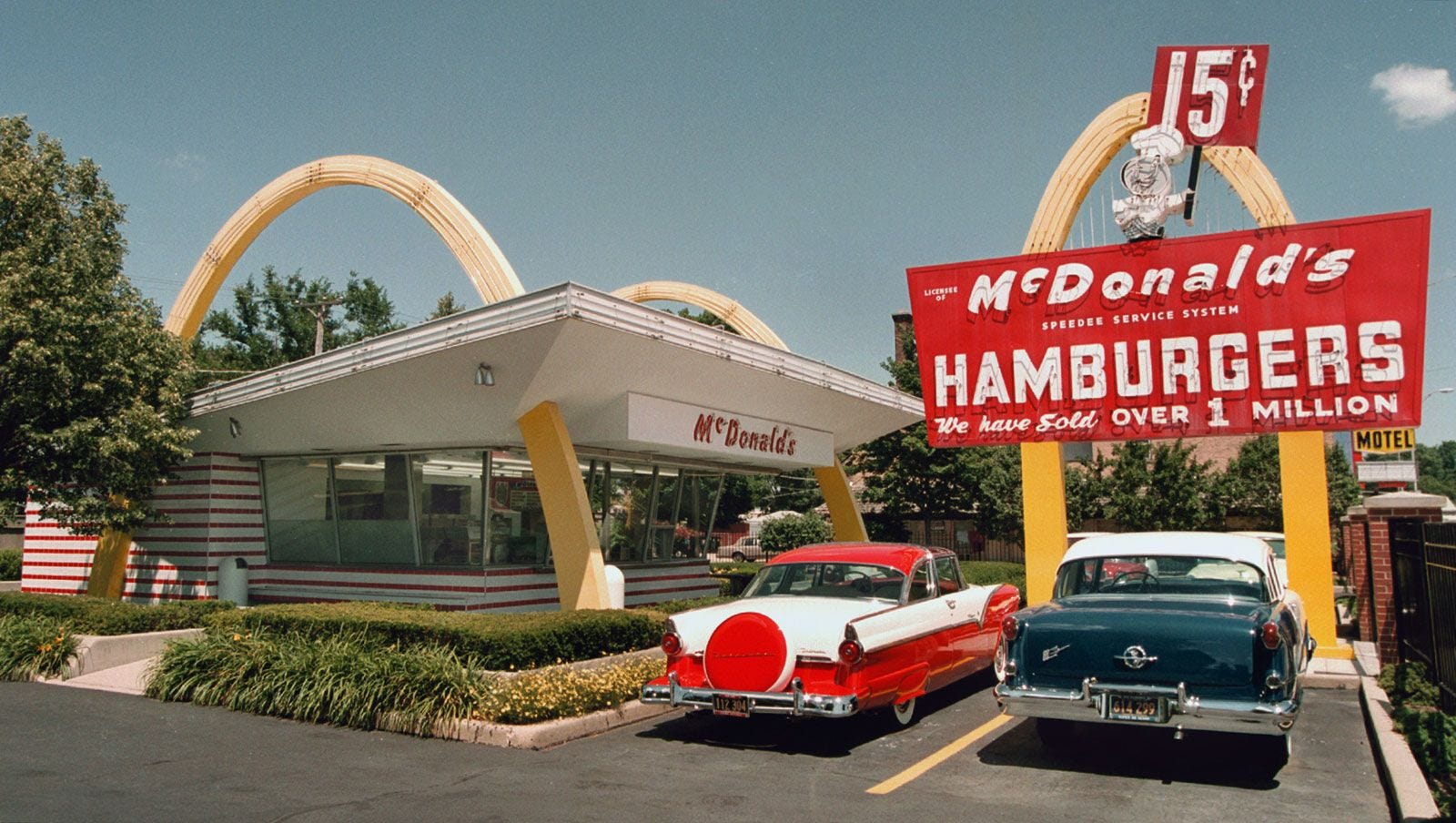
Enter the golden arches. Dick and Mac McDonalds unassumingly began selling burgers at their hot dog chain. Little did they know, burgers would soon become their most popular item, and with a little invention called the assembly line, a new kitchen design would enter the market, revolutionizing the hamburger as we know it.
The speed at which the brothers created their burgers led way to the fast food behemoth that dominates the world today. Inadvertently, however, their ingenuity also led way to the introduction of true choice when it came to burgers.
You see, an assembly line allowed for each individual component to be adjusted to the costumer’s preference. Tomatoes or no tomatoes, pickles or no pickles, cheese or no cheese. There was no cost in time; all it took was a glance at the order. As other chains began adopting this method, customizability inadvertently grew hand-in-hand. No longer were burgers confined to the whim of their creator; now everyone could, well, have it their way.
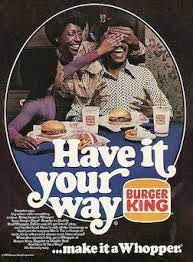
Now, there is nothing more accepting of customer choice, at least in the culinary world, than a burger menu (maybe the Cheesecake factory, but that’s an exception). What began as a humble creation with some variation is now a guide to customize and build on to your heart’s desire.
We have 10-foot-burgers, Pretzel-bun burgers, Triple meat burgers, Impossible burgers, Dessert burgers, Deep-fried burgers, Butter burgers, Chilli burgers, Chilli cheese burgers, Grilled cheese burgers, Stuffed mushroom burgers, Ramen burgers, sushi burgers, and so many more. If you can dream it, it probably exists in burger form.
It doesn’t get much more American than that.
Theseus’ burger.
I want to backtrack a little here and ask a relatively simple question: what really is a burger?
You see, creativity is a double-edged sword. With greater iterations of the burger being generated, the constraints of the term “burger” wear thin. Is a lettuce-bun burger even a burger? I don’t think so, but maybe you disagree.
This begs quite an important question about associative identity and burgers. Here, I want to spend some time looking at the common analogies used when discussing personal identity, then offer the analogy of a burger as a counterpoint.
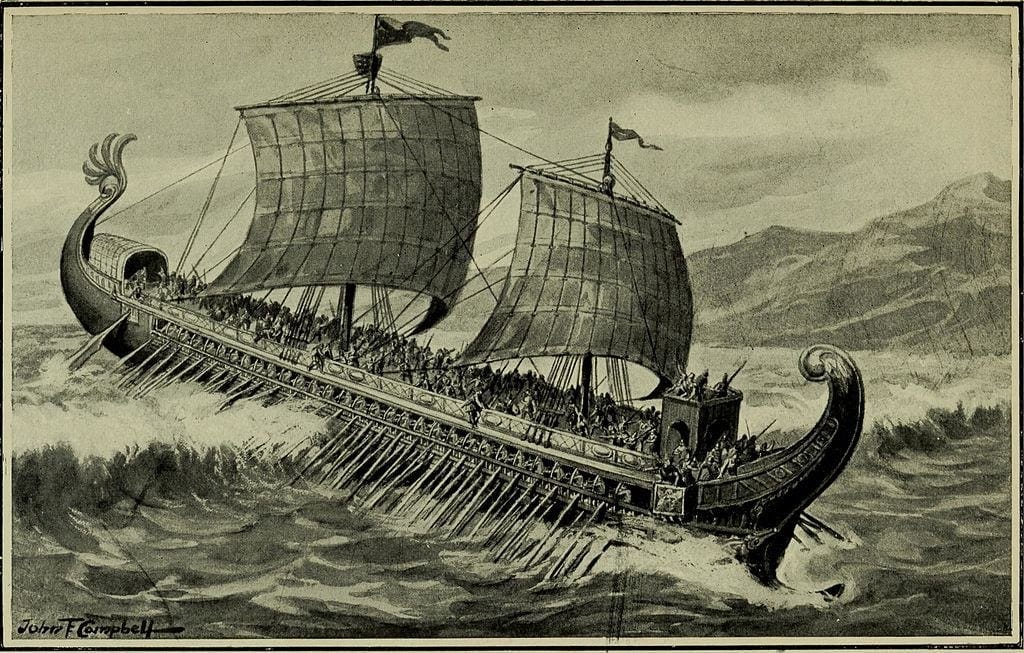
Starting with the classic: Theseus’ ship. War-hardy Theseus goes off and destroys a part of his ship. The ship is docked and repaired with some new wood. Theseus then goes off and destroys another part of his ship. Somehow, his enemies only attack un-renovated spots of the ship each time, meaning that eventually, the entire ship is now built of new material. Is this the same ship?
I remember being asked this question on our unit on personhood. In it, while observing Locke’s discussion of this analogy, we came to the conclusion that identity, and personhood, is made continuous through psychology. Locke provides four criteria specifically for personhood, and unfortunately very little for the ship.
Here’s what I think: the ship is really confusing as an analogy. There is so much ambiguity in the question. What kind of wood was used? What do we mean by ‘the same’? To some, perhaps the ship was different in a material sense and therefore different overall. To others, the ship possesses the same form and name, and therefore is the same even after all these changes.
Reconciling these views isn’t hard; the Stanford Encyclopedia of Philosophy provides a quaint answer I’ll discuss below. However, finding common ground in a Grade 12 Intro to Philosophy class with a teacher not paid enough to care makes the whole exercise needlessly frustrating and complicated.
Enter the burger.
Let’s say we have a basic burger: buns, lettuce, tomatoes, onions, patty, cheese, pickles, and burger sauce. We start by replacing the 5-minute-old lettuce with a fresh, crisp slice of Iceberg lettuce. Identical in everything but age. Is this the same burger?
To me, the instinctual answer is immediately more revealing than the blasted ship ever was. Yes and no.
Yes, in that it is the same type of burger. It would taste the same, the ingredients occupy the same area, it looks the same, and ultimately maintains a consistent form that ties it together.
No, in that we have modified it slightly to be fresher. Ignoring the differences in taste, the materials of the burger have changed.
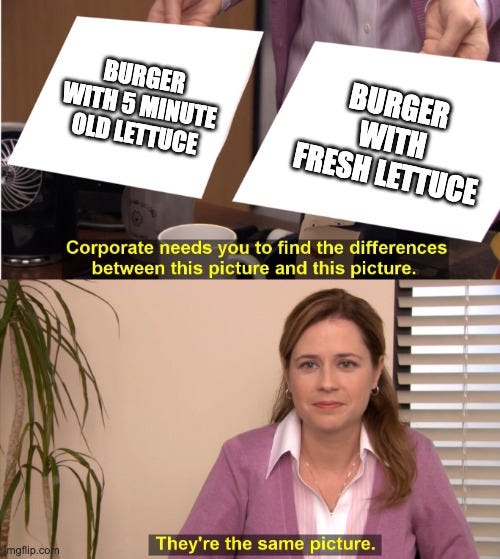
If this was brought up in class, perhaps we would’ve reached the real question much faster: what do we mean by ‘the same’? Is it defined through type, form, and space occupied, or through material and composition? The answer is open-ended; Locke would have argued the former is true(this is an over-simplification, but I am inclined to agree), a materialist would’ve argued otherwise. This is also the conclusion Stanford’s encyclopedia provides, albeit in a much more convoluted way (no thanks to the archaic analogy of the ship).
If only Theseus had a burger, maybe philosophy would be far more advanced than it is today.
A note on meaning.
I’ll be honest: this entire post is ridiculous. Bullshit. Poppycock. It takes a deranged individual to reasonably find meaning in the perceived simplicity of the burger. I’m said individual.
Initially, this post was going to be a mere musing on my insomnia and the intimate conversations I have each night with my ceiling. But much like this post, I often traverse a seemingly innocent path of logic to reach conclusions that are far more profound, deep, and overcomplicated, than the truth.
It’s natural: every text left opened, breakup without closure, or argument with a friend sends me (and others) into spirals of thought in search of an explanation.
Is she mad at me? Was I in the wrong? I hope they’re safe. I bet they hate me.

What’s worse is the search for an answer doesn’t truly lead to any semblance of comfort. Instead, the sheer uncertainty of a more hyperbolic cause being true lengthens the escapade into an endless search for gold, when all that there might be is a bunch of stone.
Humans bank on uncertainties. Gamblers risk life savings on the off-chance of being rewarded. We cling onto hope, or despair, even when all else points to a clear solution. Who knows, maybe this post is a large conspiracy by McDonalds to convince you of the philosophical side-benefits of a Big Mac. If I could connect burgers to personhood, then conflating an unopened text message to ‘hating my guts’ seems equally plausible.

But sometimes, things don’t need to be complicated. Not everything has an answer that must be unearthed through hours of spent time. Not every action is an act of malice, manufactured to sow doubt in your head. Sometimes opened texts are accidents and arguments are misunderstandings. Sometimes a burger is just a burger.
So sure, maybe there isn’t intent behind its construction. Maybe the diversity in offerings is a simple reflection of preference, and the burger is just a vehicle of this expression, no greater than any other type of food. Maybe it was all a happy accident, and some German guy simply ran out of rye bread and used buns to carry his ham. Conflating profoundness with truth and sound logic with meaning only returns wasted time and more confusion. Instead, we should learn to take things for what they are, and until explanations offer themselves up, spend time in more productive ways.
Old habits die hard.
Perhaps it is hard to unlearn the years we’ve spent overthinking. From time to time, thinking through things might be important. But the next time you catch yourself wandering through the gardens of your thoughts, ready to stumble into the rabbit hole of obsession, take a step back and order a burger.
Then, don’t shut off your mind (because god knows that’s impossible), and instead look back at this post. What other ways can you over-explain a burger? What analogies can you draw? What does a burger teach you that I missed out on? I’ll be happy to discuss the myriad of ways burgers can lead to life lessons in my DMs, if you’re so inclined (@bigmacandtanush).
Over time, diversify. Try pizzas, pastas, fried chicken. Look past foods; maybe there’s a life lesson on stability hiding under the table, or a metaphor on authority hidden in the Dewey Decimal System.

As the analogies become more creative, the absurdity of overthinking slowly becomes more apparent. Engaging in these exercises provides a fun way to break away from the pattern of destructive thought that does nothing to provide comfort to the inexplicable.
The journey to ‘just-the-right-amount-of-thinking’ starts with a burger. Will you bite?
come back the game needs you